 |
|
Copyright © 2003 J. Jeffrey Bragg |
|
|
|
Copyright © 2003 J. Jeffrey Bragg |
The Hiatus: December 1971 to January 1973
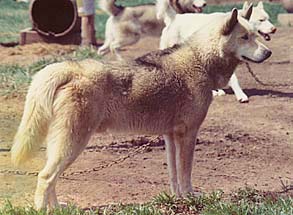 |
THE
LOSS OF DITKO did rather demoralise me. I had every
intention of breeding him to LYL and ANISETTE in spring of
1971, but both bitches had mysteriously failed to come in
season, and by midsummer my cherished McFaul stud dog was
dead. It may legitimately be asked why I did not do more
over the next year and a half than simply producing the one
litter by MIKIUK TUKTU TORNYAK out of LYL OF SEPSEQUEL. |
|
(bred by Gary Egelston, by Mikiuk Tuktu Tornyak out of Nenanah of Natomah) |
Shortly before
the move to eastern Ontario, I had acquired TONTO OF CALIVALI from
Don Hazlett, a racing driver in New York state. TONTO was bred by
Roland Bowles and was, when I bought him, a burnt-out racing leader.
He was a sweet, intelligent dog, but something of a nervous wreck
from several years in front of twelve to sixteen-dog teams. Having
lost DITKO, I now tried to use TONTO to lead my growing collection of
disparate Siberians. I did some local-area racing, including even
daring to enter the Ottawa Dog Derby; I can remember being passed by
J. M. McDougall! I acquired CHEENAH'S THRUSH, a white New England
racing bitch bred by Steve Tassey, and STAR OF CALIVALI, a grey bitch
bred by Ruby Bowles. I bought another Anadyr male from Earl Norris --
FOX OF ANADYR. From Gary Egelston I acquired a young male, NE-TUK'S
VULCAN OF MANAHTOK, three-quarters Seppala, sired by MIKIUK TUKTU
TORNYAK out of NENANAH OF NATOMAH. I even picked up from an Ottawa
area racer an amazing 25-inch-tall tricolour Siberian male out of
Marlytuk, Tassey and Bryar lines, WARLOCK'S HECTOR OF KADATUK, crazy
to run and ready to breed anything that would hold still for three
seconds. (I really did have some esoteric Siberians in the Tadluk
days!)
|
I
bred my then companion bitch CH. TROIKA'S BOIKA (who was not
a bad sleddog) to IGLOO PAK'S JAN at the Bryar kennel in New
Hampshire; I bred STAR OF CALIVALI to MALAMAK'S OKLEASIK
(with great difficulty -- never have I seen such an inept
stud dog). Before moving east I had mated CHEENAH'S THRUSH
to SEPP OF ANADYR; LASKA OF ANADYR had been bred to CH. SNOW
RIDGE CHIEFSON (whom I co-owned); a Bow Lake/Huskie Haven
bitch from Lance Heald, KENATIM'S STAR OF MER-LAKE had been
bred to my first Siberian CH. RACECREST'S OPENWOOD THUNDER,
producing a rather decent litter. So I had a great deal of
young stock to train, with the assistance of the few
experienced sleddogs that I had acquired from others. |
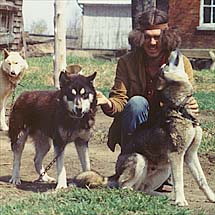 |
|
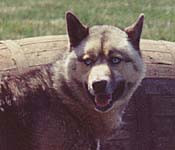
(half-Seppalas, by Malamak's Okleasik out of Star of Calivali) |
 |
It
was an appalling pile of experimental breeding; some of the
resulting animals proved totally useless. (Others went on to
become much-valued stock in other Canadian kennels, though.)
The broad experience I gained during that period of
experimentation with different Siberian bloodlines has stood
me in good stead ever since. |
|
|
A YEAR
OR MORE after I had lost DITKO, Earl Norris sent me photographs of
two brothers, VODKA OF SEPPALA and BORIS OF SEPPALA (C.K.C. was less
than careful about numerical suffixes of these late McFaul Seppalas
-- they ought to have been VODKA IV and BORIS III). The two males,
sired by RUFFO OF SEPPALA out of GAGNON'S VIXEN, were very big
long-coats. I turned them down, which may have been a mistake. Little
harm could have come of trying a litter or two from them. Had I had
only the Seppalas at the time, perhaps I would have taken them on,
but I was running two kennels then -- TADLUK and MARKOVO, with around
forty dogs on the property not counting pups! I had visions of hairy
monsters eating me out of house and home.
Other Seppalas were around at the time,
that might have been used for breeding, but they were not readily
available. Verner Zoschke of Arnprior, Ontario, owned GAGNON'S VIXEN
and GAGNON'S NANA (both born 4 January 1961); he would never have
sold or leased them. Zoschke finally came to me in 1972 with GAGNON'S
NANA, aged eleven years, whom he wanted to breed to DITKO, then dead
for a year! I talked him into trying a mating to DITKO's son HAAKON
OF MARKOVO; as in the case of Prado and his XIPE, the bitch was not
quite ready, the owner refused to leave the bitch for breeding the
next day or two, so no mating resulted. Human nature seems to have
been one of the Seppala strain's worst enemies.
Norris also offered me FRITZ OF
SEPPALA; FRITZ was out of DITKO's dam ZAZA OF SEPPALA and had a
tipped ear. I had no idea whether he might throw ears that were not
erect; breeding him to DITKO's daughters seemed like a bad idea. I
turned FRITZ down, too.
SEVERAL
PARTIES in western Québec had MALAMAK stock in the early
1970s. Johanna Wilson in particular might have founded her own unique
Seppala bloodline had she wished, for in addition to MALAMAK'S EGO
and MALAMAK'S JET she had acquired the fine Nordholm bitch EMBER OF
SNOW MYTH and her litter by EGO; she knew J. M. McDougall well and
had no difficulty buying stock from him. She had the use of DUSKA OF
SEPPALA for a litter by MALAMAK'S EGO, presumably on similar terms to
my own lease of the same bitch. Yet Permafrost Kennels founded no
Seppala line of its own.
James Orr, Pierre Trempe and Earl
Kellett (all in western Québec) had various individuals from
McDougall or from McDougall-derived lines. I might have had one or
another of the Trempe "Valecho" dogs (bred from the foundation mating
of MALAMAK'S ECHO and MALAMAK'S INCA) had I pursued the matter. At
the time I was still not fully aware of the scope and seriousness of
the breeding vacuum, nor of how many dogs would eventually die
without pure-strain issue. The Malamak bloodline seemed then to be in
no danger. I was less than enthusiastic about the Trempe dogs and
about the MAQUOIS OF SEPPALA branch generally. (Having started with
show dogs, I still had a few prejudices about general appearance in
those days -- mea maxima culpa! ) I had FROSTFIRE ANISETTE,
whose double-grandsire was MAQUOIS. MALAMAK'S OKLEASIK was a MAQUOIS
grandson as well. I did not wish to swamp the McFaul breeding with
the MAQUOIS-based Malamak stock, so I sold OKLEASIK to Gary Egelston.
I was still trying to keep my dogs close to the basic McFaul type
which in those days I saw as being quite distinct from what the
McDougall line was producing.

